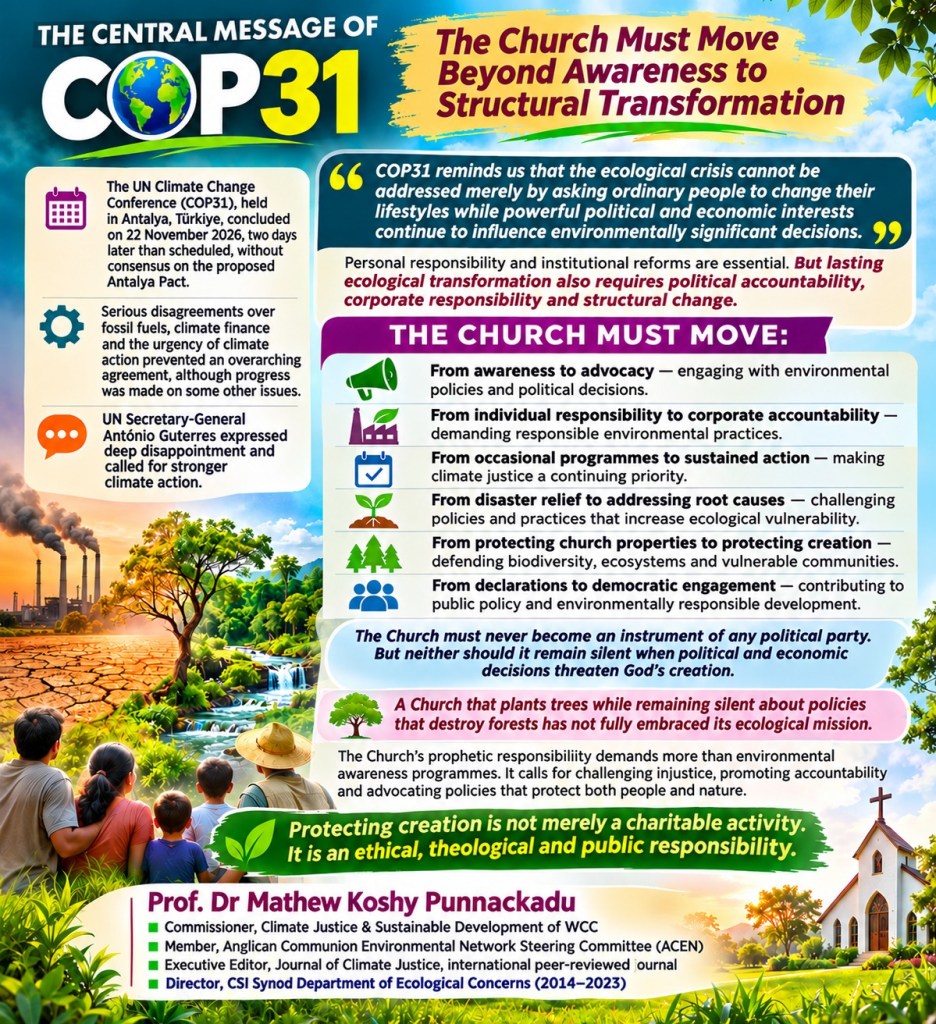
A letter of encouragement from Prof.Dr. Mathew Koshy Punnackadu, Environmental Advisor to the Church of South India | Commissioner, Climate Justice & Sustainable Development of the World Council of Churches | Member, Anglican Communion Environmental Network Steering Committee (ACEN) | Executive Editor, Journal of Climate Justice, International peer reviewed journal
The 31st United Nations Climate Change Conference (COP31), held in Antalya, Türkiye, from 9 to 22 November 2026, concluded without consensus on its proposed overarching agreement, the Antalya Pact.
This outcome is concerning, particularly as climate change, biodiversity loss, and ecological degradation increasingly threaten communities and ecosystems worldwide.
For a Church committed to the integrity of creation, climate justice and the dignity of all life, the question is not merely what governments have achieved, but how we should respond as communities of faith.
1. What Happened at COP31?
COP31 concluded on 22 November, two days later than scheduled, following difficult negotiations among participating countries.
The conference failed to adopt the proposed Antalya Pact because countries could not reach consensus on several critical issues.
Three major disagreements emerged:
Fossil fuels: Several countries called for explicit commitments to accelerate the transition away from coal, oil and natural gas. Others opposed such language or emphasized different national development and energy priorities.
Climate finance: Developing countries stressed the need for adequate and predictable financial assistance for adaptation, mitigation and addressing climate-related loss and damage. Differences remained over financial responsibilities and commitments.
Scientific urgency: Concerns were expressed that the proposed agreement did not adequately reflect the urgency of limiting global warming and reducing greenhouse gas emissions.
However, COP31 was not entirely without progress. Decisions were adopted on several technical and institutional matters, including aspects of climate adaptation, finance and just transition. Voluntary initiatives also advanced cooperation on electrification and other climate-related activities.
The United Nations Secretary-General, António Guterres, expressed deep disappointment over the failure to reach an overarching agreement and emphasized the need for stronger climate action.
The central lesson from COP31 is that international negotiations remain essential, but political disagreements must not become an excuse for delaying ecological responsibility.
2. What Does COP31 Mean for the Church?
The outcome of COP31 raises an important ethical and theological question:
When governments struggle to agree on adequate measures to protect the planet, what responsibility falls upon communities of faith?
The Church cannot replace governments or international institutions. However, it has a distinctive responsibility to awaken moral consciousness, promote justice, mobilize communities and demonstrate responsible ways of living.
The integrity of creation is not simply about planting trees or maintaining clean church compounds. It is about recognising that human beings are part of an interconnected community of life.
Our theological convictions provide a strong foundation for ecological responsibility.
Creation has intrinsic worth. Genesis 1:31 affirms the goodness of God’s creation. Nature has value beyond its usefulness to humanity.
Human beings are custodians, not absolute owners. Genesis 2:15 reminds us of our responsibility to care for and protect creation.
All creation is interconnected. Psalm 104 celebrates the diversity and interdependence of life. The destruction of biodiversity damages the delicate relationships that sustain ecosystems.
Climate justice is inseparable from social justice. Micah 6:8 calls us to act justly and walk humbly with God. Those who have contributed least to climate change often suffer its most severe consequences.
Creation participates in God’s redemptive purpose. Romans 8:19–23 portrays creation as groaning and awaiting liberation. Our Christian understanding of redemption must therefore include concern for the whole created world.
These biblical insights remind us that ecological responsibility is not an optional programme of the Church but an integral dimension of Christian faith, discipleship and mission.
3. How Should the Church Respond?
The Church’s response to COP31 should move beyond expressions of concern towards sustained and measurable ecological action.
I would suggest the following priorities.
1. Make every parish an ecological witness.
Every parish should be encouraged to undertake a simple environmental audit covering electricity, water, waste management, land use and biodiversity, followed by a practical action plan.
2. Integrate climate action with biodiversity conservation.
Reducing carbon emissions is essential, but climate action alone is insufficient. Churches should promote the conservation of native forests, sacred groves, wetlands, rivers, mangroves and other natural habitats.
Planting thousands of trees cannot compensate for the destruction of a natural forest. Protecting existing ecosystems is often more ecologically significant than creating artificial plantations.
3. Stand with climate-vulnerable communities.
Churches should strengthen their capacity to respond to floods, landslides, droughts, extreme heat and coastal erosion, particularly among economically and socially vulnerable communities.
4. Integrate ecological education into Christian formation.
Sunday schools, youth fellowships, women’s fellowships, theological seminaries and educational institutions should incorporate climate science, biodiversity conservation, environmental ethics and sustainable living into their educational activities.
5. Reduce the Church’s ecological footprint.
Churches and institutions should promote energy conservation, renewable energy, responsible water use, waste reduction and environmentally sustainable practices.
6. Strengthen local climate adaptation.
Parishes can work with local authorities and community organisations to develop disaster preparedness, water conservation and climate resilience programmes.
7. Encourage responsible public engagement.
Churches should contribute constructively to public discussions on environmental protection, sustainable development and climate justice, drawing upon scientific evidence and ethical principles.
8. Support sustainable livelihoods.
Pay special attention to farmers, fisherfolk, agricultural labourers, and communities whose livelihoods are increasingly affected by climate change and ecological degradation.
9. Strengthen ecumenical and interfaith cooperation.
Environmental concerns transcend religious and denominational boundaries. Churches should collaborate with other faith communities, scientific institutions and civil society organisations.
10. Establish mechanisms for monitoring ecological commitments.
Evaluate environmental programmes based on measurable ecological improvements rather than the number of events held.
For example, instead of reporting that 5,000 saplings were planted, we should examine how many native trees survived, whether biodiversity improved and whether the activity contributed meaningfully to ecosystem restoration.
4. A Proposal for the Church of South India: Creation Care Commitment 2027
In light of the outcome of COP31, I would suggest that the Church of South India consider a Creation Care Commitment 2027, inviting every diocese and parish to undertake three practical responsibilities.
Protect Creation: Identify and conserve at least one locally significant ecosystem, habitat or biodiversity resource.
Reduce Ecological Harm: Establish realistic annual targets for energy conservation, water management, waste reduction and sustainable resource use.
Promote Climate Justice: Identify climate-vulnerable households and communities and initiate programmes to strengthen their resilience and well-being.
Each diocese could encourage its parishes to prepare a simple annual ecological action plan and review its implementation.
Such an initiative would enable the CSI to show that its commitment to the integrity of creation is expressed not merely through declarations and observances, but through practical, measurable action.
5. From Environmental Awareness to Ecological Transformation
COP31 reminds us that international climate negotiations, although indispensable, cannot by themselves bring about the ecological transformation humanity urgently needs.
The Church’s mission must therefore be both prophetic and practical.
It must be prophetic in speaking for climate justice, scientific responsibility, vulnerable communities and the voiceless elements of creation.
It must be practical in demonstrating environmentally responsible lifestyles, protecting biodiversity, reducing ecological harm and strengthening community resilience.
The Church must move from occasional environmental programmes to sustained ecological commitments, from awareness to transformation, and from declarations of concern to measurable action.
The world does not need a Church that merely speaks about the ecological crisis. It needs a Church whose life, institutions and actions demonstrate that another way of living is possible.
May our commitment to the integrity of creation become a visible expression of our Christian faith and mission.
Visit the takenote.ca HOME page for a colourful display of hundreds of other blogs which may interest or inspire you


Leave a Reply