Guest blog — THE REVEREND LAUREL DYKSTRA
Priest, Salal + Cedar; Vicar, St. George’s, Fort Langley
This article first appeared in TOPIC, the Newspaper of the Anglican Diocese of New Westminster, Canada.
“The geographical pilgrimage is the symbolic acting out of an inner journey.” Thomas Merton
From the 17th Century allegory Pilgrim’s Progress, to Annie Dillard’s 1970s bestseller Pilgrim at Tinker Creek, to the backpacks-and-blisters social media travelogs of friends on the ancient Camino de Santiago, the practice of pilgrimage has been part of the vocabulary and practice of Christian spirituality since at least the 4th Century.
The idea of the spiritual life as a journey and the embodied practice of walking to a sacred site are not unique to the Christian tradition; the Muslim hajj, Aboriginal Australians walking songlines through the outback, and Hindu tirthayatra are examples from other spiritual traditions. But there is a current resurgence of interest in, even a longing for, the simple embodied practice of pilgrimage.
Social critic Rebecca Solint describes it this way, “I like walking because it is slow, and I suspect that the mind, like the feet, work best at about three miles an hour. If this is so, then modern life is moving faster than the speed of thought, or thoughtfulness.” But in an age of climate crisis and economic uncertainty, a weeks-long trip and air travel to a distant location doesn’t make sense for everyone.
The good news is that Anglicans in the Ecclesiastical Province of BC and Yukon have been experimenting with local pilgrimages, focused on paying attention to the sacred in our own backyards and under- standing our place in God’s creation.
For 23 years Phil McIntyre-Paul has offered a course at Sorrento Centre called 21st Century Pilgrims: Walking on Holy Ground. On a week of contemplative day hikes in the Shuswap, participants walk the trails, reflect on wisdom from naturalists, poets, rascals, and saints, and consider their role in local ecosystems.
In 2016, Bishop Logan McMenamie of the Diocese of British Columbia (now called “Islands and Inlets”) made a 20-day, 470 km symbolic walk of contrition and repentance for the Anglican church’s role in colonizing the land. His focus was on re-entering the land and renewing relationships of repair with First Nations.
Salal + Cedar Watershed Discipleship Community had several day-pilgrimages during the pandemic, and the churches of North Vancouver and Kingsway have held deanery events where pilgrims walk together from church to church. To bless Hineni House, an intentional faith community for young adults, St. Margaret’s Cedar Cottage revived the ancient tradition of “beating the bounds,” where a congregation would walk the perimeter of the parish, striking boundary markers (and sometimes young parishioners!) with branches.
In a related practice, many congregations in the diocese have begun “greening” their Palm Sunday processions, using abundant native plants or invasive species instead of importing palms.
About five years ago, the Reverends Alicia Greenfield and Ken Gray, of the Ecological Working Group of the Ecclesiastical Province of British Columbia and Yukon, began compiling resources and promoting the idea of local pilgrimage. Under their tutelage and encouragement, members of St. George’s, Fort Langley, have come up with their own unique take on the practice: the Sparrow Creek Farm Eco Pilgrimage.
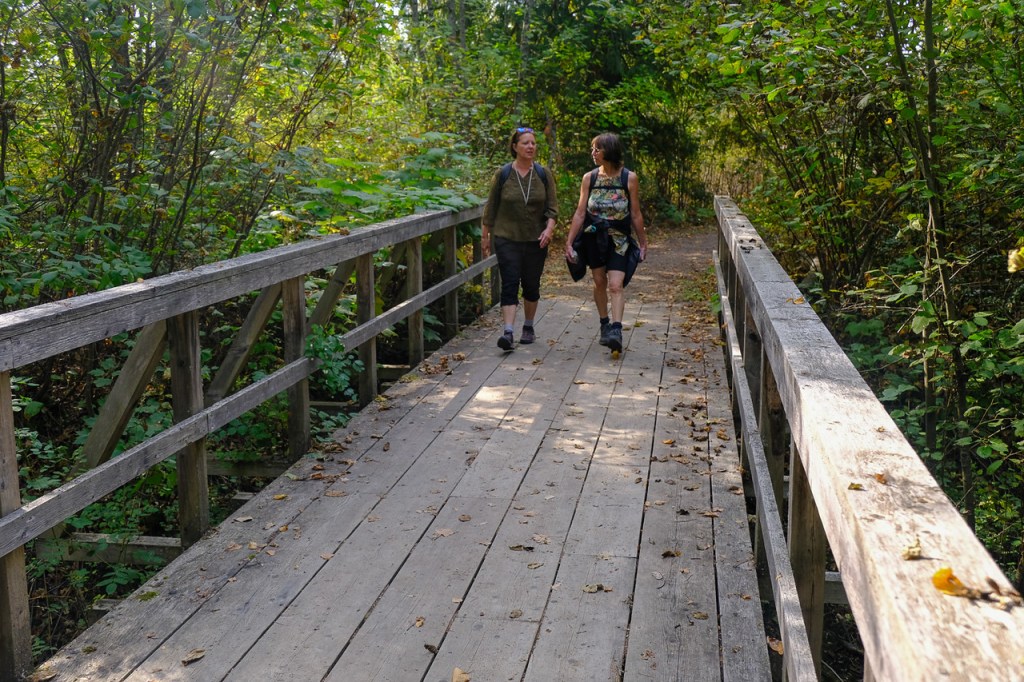
On the appointed day, quiet groups of two to five people set out at 30-minute intervals to walk a loop on a small acreage in Langley. A local conservation organization has a table with information about habitat, ecosystems, and what animals they might see. Each pilgrim receives a printed guide, and the image of an animal guide stamped on a wooden medallion: this year it is a beaver. At each of half a dozen reflections spots: pasture, wetland, coniferous forest, farmyard etc. the printed guide offers prayers, reflection questions, quotes from poets, naturalists and spiritual practitioners, and a likely species list. But the real emphasis is on slowing down and offering the gift of attention. After walking the pilgrimage route participants gather for refreshments and sharing, and in the evening, they meet at the church for a meal and celebrate the Eucharist.
Like most of the other examples, the Sparrow Creek Eco pilgrimage focuses on intentional, local walking as a way of tending to our relationship with God, but this pilgrimage is unique in its focus on community relationships.
Parishioners Roy and Sue Cline welcome pilgrims to the land they have stewarded and restored, the Outreach Committee at St. George’s forms the planning team, and the work was supported by the BC/Yukon Social and Ecojustice Working Group. Those collaborations within the church are not so surprising. But the participation of the local Guide troop and the Fraser Valley Conservancy makes this a real community event. Conservationists have the chance to meet Christians who have an active concern for ecological justice.
Neighbours of all ages, who might never come to a service, are invited to try out a low-barrier spiritual practice that has meaning for them.
For those considering joining Walking Towards Enchantment, a pilgrimage scheduled for the fall at the Sorrento Centre go here for information and a personal invitation.
For those considering planning and hosting your own local event assistance and encouragement can be found here.
 Take Note - Reflections on life, music, politics, retirement and more by Ken Gray
Leave a comment