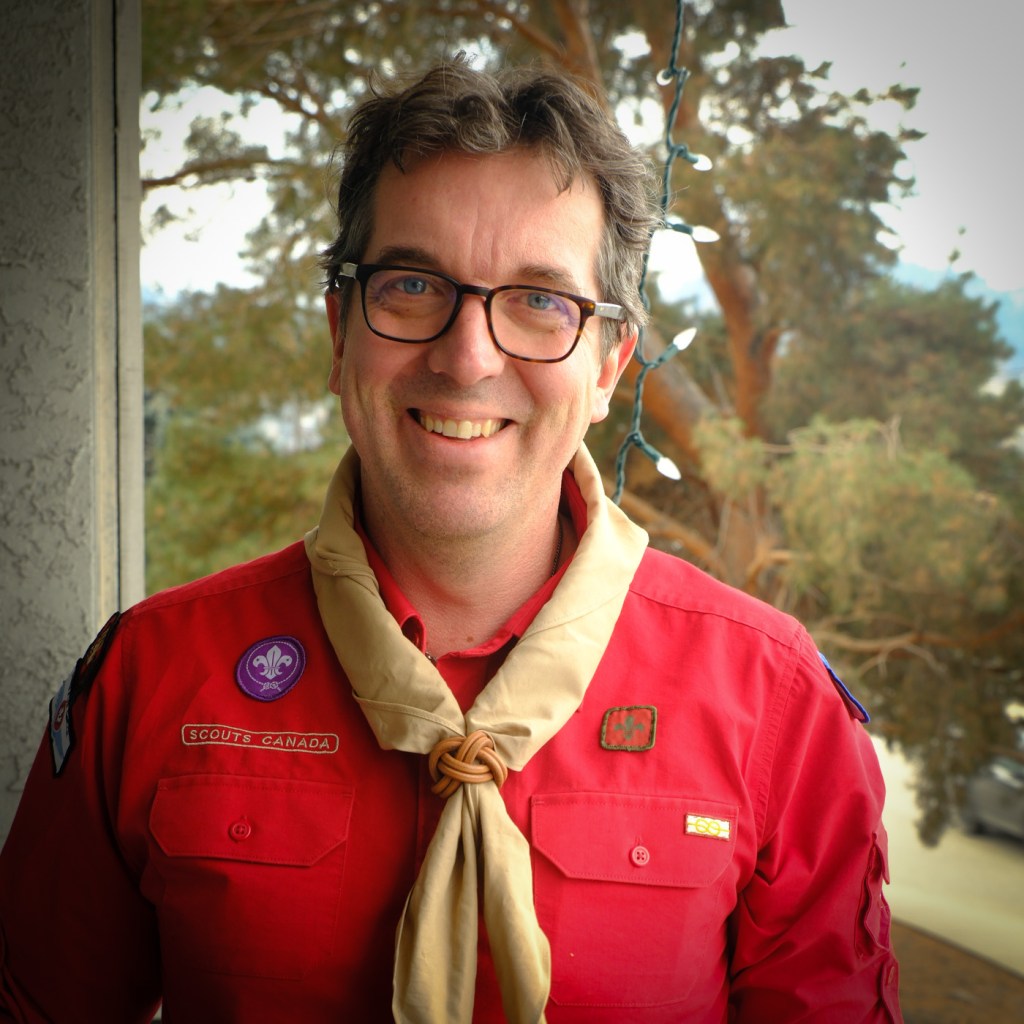
[Ken Gray] The Rev. Chris Parsons (Executive Archdeacon of the Anglican Diocese of Kootenay) and I have been clergy colleagues for many years, now in the Diocese of Kootenay, and previously in the Diocese of Islands and Inlets (BC). We each know the peaks and troughs of working in ordained leadership, especially within the Anglican Church of Canada — Some days are better than others. In conversation recently I asked Chris how he deals with stress and discouragement. He quickly offered that he loves being a scout leader. I didn’t know about his connection with scouting, so I asked him to write about this vocation. His response is below. Enjoy.
[The Rev. Chris Parsons] While in the Diocese of Toronto I started helping out as a Scouter, or Scout Leader with the only community service-based organization to remain active despite COVID-19 restrictions. I joined with my youngest daughter as we knew that it would help her find like-minded youth for someone who had recently moved to the area from Germany.
Another reason why I am a Scout Leader is because I grew up being active in the scouting community and I value the outdoors. In fact, much of my early experiences in the outdoors was foundational to my Christian calling.
Scouts offered me a place to be with friends, and to be given a lot of responsibility — Shop for food, pack bags, read maps, all the events were run with youth input with little adult supervision. Adults were there to guide, not necessarily tell us what to do. So as a learner by doing, it offered me a great opportunity.
I am also a Scout Leader because I care about youth, and I want to give back the fun experiences I had. Of course there is the wider framework which emphasized the founder Lord Baden-Powell’s focus on leadership, responsibility, teamwork and resilience. It is truly a global organization, and more and more youth still experience the joys and challenges of being a scout.
There are also selfish reasons. I attend for the social element. What started as a means for my daughter to meet other young people, I continue now to meet adults who are committed to providing young people an opportunity to grow.
I am also a Scout Leader because I receive as much as I give. Working with youth keeps me grounded, hopeful, and attentive to what really matters. It reminds me that leadership is about listening, encouragement, and example — not about trying to control specific outcomes. The ethos of being aware of King and Country, and of the value and practice of doing things for others, and being responsible with nature are all part and parcel of why I meet from week to week.
Scouting challenges me to live the values I hope to pass on to others: integrity, respect, service, and care for the natural world. There is always a surprise as you watch young people grow into adults, and even come back to help in leadership.
Ultimately, I am a Scout Leader because I want to help build a community where young people feel capable, valued, and prepared to contribute positively to the world around them.
This is not the first time I have been in leadership. After aging out of the Venturer’s program which is for youth after scouts, I was asked to be a leader (helper) with my Scout leader as a troop of scouts went for a four-day hike/camp. I discovered that the idea of youth-led camping was difficult for me to receive — going the wrong direction until they understood that the map wasn’t oriented correctly, for instance. Eating nearly burnt food, getting upset as some of the troop found a survival kit and promptly burnt it on the fire, while others watched unopened canned food burst open — if this is leadership, count me out. I’ve never looked at sardines the same way.
Then, there was looking after the equipment where a rock-paper-scissors session required the looser to stay at camp to clean up all the dishes while the rest went for a hike to the top of a nearby mountain. When we arrived back to camp the youth doing dishes was still doing dishes. He burst out that he had tried his best but could only get half the stuff off the frying pan. Lifting up the pan in one hand, and a well-used blue SOS scrubbing pad I saw that he had skillfully taken all the food off along with half the Teflon coating.
Little did I know that more disaster was waiting.
In the evening, a large storm blew through, and about one in every three large Lodgepole Pine trees were knocked down across the trail. The leader went ahead with a saw and started clearing a path so that we didn’t have to hurdle over downed trees with heavy packs. After a long time he came back and promptly threw his back out. He was bent over and in tremendous pain.
Eventually, we decided to abandon the wilderness camp and head for a well-known provincial park to conclude our camping, again through another storm. The van we used to get to our location had a flat tire when we returned to it. Fortunately, someone drove down the dirt road and rescued us from our distress.
While nowhere ideal, we all remembered the camp, and importantly learned a lot of things that we had not known before – like Teflon coated pans. It would be many years later that I returned to Scouting in any kind of leadership role. I am thankful I did as some of my best friends came through scouting experiences — fellow scouts from when I was young, and leaders with whom I worked side by side over many years. All of this has been because of the moments of success and the learning opportunities.
Visit the takenote.ca HOME page for a colourful display of hundreds of other blogs which may interest or inspire you


Nice! Brings back many memories of being a Girl Guide leader (Guides … and mom of 4 Brownies) … and even a Beaver Scouts leader (and mom of 1 Beaver)!
LikeLike